
In the late 00s, the biodynamic Guerila winery from the Vipava valley in western Slovenia had a renowned importer in a Northwest-European country. But Slovenian wines were a hard sell and after some years the relationship ended. Surfing the waves of the natural wine movement, Slovenia then built a reputation in this niche. However, interest in natural wine is now stabilising or even waning, according to several winemakers I spoke to in Slovenia. Korenika & Moškon from Slovenian Istria, a forerunner in biodynamics and skin-contact wines from white grapes, has changed its style considerably in recent years - less skin, more origin. When the Slovenian branch of Demeter decided last year to lower the maximum amount of sulphite allowed, it also decided to step out of this certification scheme, although Korenika continues to work biodynamically. A number of wineries, including Guerila and Korenika, are now choosing to focus on the expression of their terroir. Their vehicle is the organisation Slovenska Velika Lega (SVL), loosely translated as the Slovenian Grand Cru. This way they hope to get their individuality across more clearly.
SVL was founded in 2021 by four wineries, Edi Simčič from the western wine-growing region of Brda, Vino Gross from eastern Slovenian Štajerska, Šuklje from Bela Krajina on the border with Croatia and the Marof winery from the Prekmurje region in the far northeast of the country. The four were (and still are) dissatisfied with the current Slovenian wine legislation, which hardly acknowlegdes the concept of terroir and, insofar as it does, it is mainly determined by the cooperatives. Areas with special qualities for viticulture are either too broadly defined or not defined at all. Many wineries are more concerned with brand-building rather than exploring the relationship between the wine and the vineyard.
Soil differences
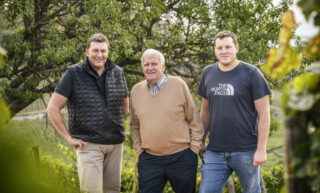
By focusing on historical wine-growing regions and on a division into regional, village and vineyard wines, the group hopes to communicate more clearly, both at home and abroad, what Slovenia stands for. Oenologist Guillaume Antalick (main picture), the club’s president and co-owner of Šuklje winery, takes SVL’s mission very seriously. For example, within his main vineyard, Vrbanjka on the Plešivica hill, he is looking for the plot that produces the best Blaufränkisch. He is now at a point where, if the vintage allows, as for example in 2022, he bottles the central, most limestone-rich part of the vineyard separately. Tasting seven vintages, the 2022 indeed stood out: the tannin was higher but velvety, and the wine had more density and intensity than the other, also very good vintages.

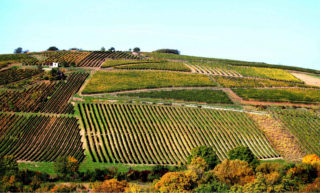
Brda vineyards ©Shutterstock
Vintage variation
By presenting three vintages of his Lozice Sauvignon Blanc, Antalick showed that the weather during the growing season has a huge influence too. A lecturer at the University of Nova Gorica, he explained to me in great detail that the large amount of rain in the period between fruit set and veraison in 2023 changed the structure of the grape skin. This caused more phenolic components to leak into the juice during pressing, giving the wine more grip and a spicier character. By contrast, the 2021 was hugely fruity. ‘In 2021,’ Antalick explains, ’we had a period of relatively cold nights in September, during the last part of ripening when the water supply to the grape is already cut off. This allowed the aromas to develop wonderfully just before harvest.’
Likewise, all other SVL wineries are exploring their vineyards. To label their wines as a regional (okoliš), village (vas) or cru (lega) wine, there are rules for the maximum yield per hectare and the release date. SVL members also determine per region what the traditional and recommended/allowed varieties are.
Biodiversiteit
Due to its location between Italy, Austria, Hungary and Croatia, it is hard to say what makes Slovenia unique as a wine country. Brda and Italian Collio are actually one region, as are Štajerska and Austrian Styria. In Prekmurje, the wines lean more towards Central Europe, while Slovenian Istria is in many ways an extension of Croatian Istria (or vice versa). Perhaps it is precisely this diversity, that makes Slovenian wines so interesting.
SVL’s work helps to highlight this diversity.
Antalick emphasizes something else: ‘One of the unique aspects of Slovenia is that there is relatively little monoculture, so biodiversity is high.’ Slovenia is indeed one of Europe’s most forested countries – 60 per cent of its area is covered with trees – and with the exception of Slovenian Istria, I have seen almost no large-scale viticulture.
Communism
You could compare SVL to ÖTW (Österreichische Traditionsweingüter) or STK (Steierische Terroir & Klassik Weingüter) in Austria or VDP (Verband Deutscher Prädikatsweingüter) in Germany. However, with around 14,000 hectares of officially registered vineyards, Slovenia is a small wine country. This is also reflected in the number of SVL members, currently 10.
Due to decades of communist rule, cooperatives have played an important role in Slovenia, even more so than in other countries. Only in the 1980s, when the regime began to crumble, were winemakers given some leeway to work independently. Compared to Germany or Austria, this still leaves the country somewhat behind in terms of origin orientation. But while I was in Slovenia, two new membership applications came in. SVL has clearly set something in motion.

Andrej Slapšak and his Blanc de Blancs ©Bart de Vries
Sparkling wine charter
Since the Bjana (Brda) and Slapšak (Dolenjska) wineries joined SVL, there is also a special charter for sparkling wines. After pressing the hand-picked whole bunches, these must be made in the traditional method, including a minimum of 15 months of lees aging for non-vintage or 36 months for vintage wines. Bjana exclusively uses pinot noir and chardonnay for its highly competent classic sparkling wines, while Slapšak, apart from chardonnay for its fantastic Blanc de Blancs Peśće, focuses on the indigenous, high-acid varietal žametovka. (For lovers of trivia, the world’s oldest vine, 400 years old, is a žametovka and stands in the center of Maribor).
Both wineries take an extremely precise approach, which is reflected in the outstanding quality. In doing so, Andrej Slapšak also puts his experience as an engineer to use. For pressing the grapes, he developed his own, wireless sensors that can measure the pressure in the center of the pneumatic press, exerted by the membrane, even more precisely than a standard press would do.
Good value
The fact that SVL is taken seriously does not only become apparent by its gradually growing membership, but also by who its members are. The entry of Domaine Ciringa, the Slovenian wine estate of the famous Austrian Tement family, has given the stature of the association a big boost. Ciringa’s vineyards blend seamlessly into Tement’s vineyards (including Zieregg), but on the Slovenian side of the border. If you want to put it somewhat irreverently, with Ciringa’s Pruh you have a great Grosse Lage Sauvignon Blanc for half the price. Actually, most SVL wines are very good value. Despite this, it is still not easy to sell Slovenian wines, says a representative of an importer of Ciringa’s wines. But with SVL and its focus on origin, the country is now moving in a clear direction. Together with the high quality I encountered at each of the wineries I visited, it should pave the way for a bright future.
-+-+-+-+-
I tasted between five and twenty wines per winery. Below you will find, per winery, one or, if I really couldn’t choose, more of the most striking, tastiest, and/or best wines.
Marof
Uroš Valcl comes originally from Slovenian Styria where his parents had a small winery. (He still makes a few wines here.) After studying agricultural sciences in Maribor, he started working as a winemaker. Marof’s cellar has a considerable overcapacity, so there is always room for long maturation and to experiment with micro-vinifications. The wines have a beautiful purity across the board, without losing power and depth. His white wines often undergo a short, cold soak that gives the wines just a little bit of bite. Possibly the most consistently good portfolio of the nine wineries I visited.
– Kramarovci Chardonnay
– Mačkovci Blaufränkisch

Michael Gross and his wines ©Bart de Vries
Vino Gross
Michael Gross is the brother of Johannes Gross of the Austrian winery of the same name in Styria. The family came into possession of the vineyards in Slovenia through a woman who had received land back from the Slovenian state through a denationalization program in the 1990s. Michael cultivates his beautifully terraced vineyards in the Haloze subregion, a part of Slovenian Styria (Štajerska), biodynamically and has a more or less zero/zero approach in the cellar, but he isn’t dogmatic. The wines are about structure and texture, and less about fruit, and are in my opinion the most idiosyncratic of the entire SVL group.
– Haloze
Haloze is a cuvée of Sauvignon Blanc, Furmint and Welschriesling. The planting density in Haloze is very low, 1000 to 2000 plants per hectare, which gives plenty of room for biodiversity. The soils therefore have a high content of organic matter. The 2022 vintage is slightly oxidized with a core of ripe fruit and lively acidity. The 2023 was smoky, full of citrus and had a pleasant texture reminiscent of lemon rind.
Domaine Ciringa
– Pruh Sauvignon Blanc
The 2020 vintage showed beautiful pure fruit, especially in the berry part of the spectrum. The 2019 vintage was the most reductive with aromas of lightly roasted sesame and even something coffee-like. “Typical for the vintage,” according to Armin Tement. The 2015 matured on the lees for 66 months and was still quite closed and tight, also a bit lactic. The most accessible vintage was 2017: full of white grapefruit, cassis and blackcurrant leaf. Ultra-fine acids, filigree texture, perfectly balanced.
Edi Simčič
– Rebula Fojana Sveti Duk
– Chardonnay Fojana Srednji Kos
– Sauvignon Blanc Fojana Dolina
Edi Simčič’s white wines are somewhere between Burgundian elegance and Mediterranean warmth. “The use of wooden barrels is part of Simčič’s house style,” says Jacob Simčič, the third generation. But the way he, his father Aleks and brother Jure do it is extremely subtle and balanced.

Matej Korenika and his wife Tina Kotrle ©Korenika + Moškon
Korenika & Moškon
– Bankina Malvazija
Matej Korenika took over his father’s business at a young age. Despite his 47 years, he already has 25 years of experience. Since 2007, he has been making this Malvazija from seventy-year-old vines in the Bankina vineyard, which is only a few meters above sea level. Beautiful subtle fruit, slightly smoky, a typical light note of blanched almond, round fresh acids (no malolactic conversion), rich and vertical.
– Kortinca Refošk
The grape variety Refošk – the names Teran or Terrano are also used – is not the same as Refosco dal Peduncolo Rosso. Because of its deep color, Refošk is also locally called black wine. I tasted the 2024 vintage straight from the barrel. Very promising. Spicy, fresh, cool silky tannins, deep and long. Based on the village (vas) Refošk from 2020 that I also tasted, I expect this Kortinca to be able to mature for a long time.
Vinska Hiša Bjana
– Cuvée Prestige
Bjana specializes in sparkling wines from chardonnay and pinot noir. Miran and Petra Sirk, the owners, vinify the grapes from each plot separately. In 2024, this yielded 49 different base wines. The Cuvée Prestige is a blend of the best.
Guerila
With the name Guerila, the owner wants to express the revolutionary character of the winery: Biodynamic and low intervention. At the beginning of this century, Zmagoslav Petrič and his operational manager Martin Gruzovin were certainly among the first. But there is no haggling over the quality. As long as it goes, they stick to the rules of Demeter Slovenia, but, if necessary, they step out, just like Korenika.
– Pinela Classic
Pinela is one of the varieties that is exclusively planted in the Vipava Valley. At least, according to Petrič and Gruzovin. Jancis Robinson et al. write in their book Wine Grapes that no DNA research has yet been conducted to determine whether the Slovenian variety and the Italian variety Pinella are really different. Classic is Guerila’s entry-level series. The Pinela gives a lot of drinking pleasure due to its acids, has a nice grapefruit character, but also leans towards the tropical. Slightly viscous in texture.
– Barbera Amphora
The presence of barbera betrays the proximity of Italy in western Slovenia. This example, matured in amphora, is deeply berry-ish, with a hint of mint and invigorating freshness. Quite powerful, but the alcohol is well integrated.
Domaine Slapšak
The winery, which specializes in sparkling wines, is located in the idyllic region of Dolenjska. Rolling hills, babbling brooks and when I was there, a clear blue sky and blooming wild cherries. The region is best known for its Cviček, a thin, sour quaffer, but Slapšak is taking the area in tow towards a quality-oriented future. Andrej Slapšak is supported by co-owner François Button, a Champagne-born winemaker with experience at Roederer.
– Blanc de Blancs Peśće
Blanc de Blancs is made exclusively from the juice of the first soft pressing. Five years of maturation on the lees, 2.4g dosage. Small production, but if you can lay your hands on a few bottles, you have something very special. Ripe lemons, brioche, a bit of wild flowers, fine persistent mousse, very precise, long finish.
Šuklje
Frenchman Guillaume Antalick and his Slovenian wife Katja Šuklje are both oenologists and met at the University of Wagga Wagga in Riverina, Australia. Their scientific work and the activities at their winery complement each other perfectly. They also co-own a good wine bar in Ljubljana where you can taste a large part of their wines and eat well.
– Lozice Sauvignon Blanc
– Vrbanjska Blaufränkisch
Comments