
A Window on Bündner Wine
In a country that consumes 99 percent of its own wine, finding a restaurant that has an extensive Swiss selection is easy, but finding a restaurant that exclusively features all the wineries and wines of a single appellation is rare.
Alter Torkel in Jenins, a village in Graubünden, in eastern Switzerland, somehow miraculously fits the bill. It may not be the first restaurant to put wine before food, but I have yet to come across one that takes this philosophy to such extremes.
As a balmy foehn and radiant late-winter sun warm the crisp mountain air, the terrace at Alter Torkel slowly fills up for lunch. Guests, including myself and my lunch companion, settle into chairs that are snugly lined with soft furs and don sunglasses to take in the view of the snowcapped mountains that skirt the valley where the invisible Rhine makes its way north. Just below the terrace, thousands of freshly pruned vines accumulate energy for the new season.
Alter Torkel is a wine-focused, 80-seat, casual fine-dining restaurant run by Oliver Friedrich and his wife Julia. The Friedrichs feature all 76 vintners associated with the cantonal trade association “graubünden WEIN,” which also owns the premises. This effectively makes Alter Torkel an unrivaled showroom for Bündner wines.
“It’s affordable Burgundy,” Friedrich says. With Pinot Noir’s dominance — almost 70 percent of Graubünden’s vineyards are planted to this variety — and Chardonnay as the canton’s (distant) third, Friedrich’s point is clear. Indeed, many of the Bündner Pinot Noirs and Chardonnays present good relative value. The top Pinots fall roughly in the same price category as the top Spätburgunders from Baden.
Graubünden and Burgundy both feature limestone soils and are located at roughly the same latitude. Graubünden has the advantage of a slightly cooler climate, generally resulting in a somewhat lighter style. In addition, Bündner winemakers not only work with French, but also with Swiss and German Pinot clones, so one could argue that the Bündner Pinots have the potential for greater complexity (if several clones are used for one wine) and show more diversity. With Burgundian wines at the peak of their popularity, it seems only logical for Alter Torkel to focus on these local counterparts.
Friedrich collected extensive experience with Bündner wines while working as the head sommelier and restaurant manager at Andreas Caminada’s triple-starred Schloss Schauenstein in nearby Fürstenau. With local produce at the core of Caminada’s culinary philosophy, the two wanted to local pairings. However, at that time (around 2009), “people said we were mad,” Friedrich recalls. “Graubünden, we were told, counted just two serious wineries: Gantenbein and Donatsch.” But the ambitious hospitality pros held to their convictions, and soon there was an optional, Bündner-only wine pairing for Caminada’s tasting menu. It instilled a lasting love for Graubünden and its wines in Friedrich.

Terrace Alter ©Bart de Vries
Building a restaurant identity around the wines of just one small appellation (420 hectares) with just one dominant variety reveals four other things:
First, the diversity of varieties is greater than you may expect. Indeed, the relaxed rules of most Swiss appellations, in particular with regard to the number of permitted varieties, give Alter Torkel a large range of wines to choose from. Graubünden doesn’t have any restrictions; around 45 varieties are currently grown commercially. When I visited, the by-the-glass section of the wine list featured 14 varieties, including the autochthonous Completer.
Second, a large number of styles is available. Besides the still wines (white, red and rosé), the menu offered two sparkling wines, a Kabi, a sweet Merlot, and a Pinot Noir Eiswein. Options were available in two other dimensions — natural versus conventional and ethereal versus full-bodied — even if the first wasn’t explicitly mentioned.
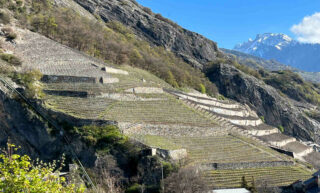
Third, the Graubünden appellation may be small, but it has diverse geography. Most wineries are located on the debris cones (conical accumulations of loose rock fragments at the base of a slope) dotted along the foot of the mountains like big dollops of cream along a cake, in a handful of villages in the Rhine valley in the north of the canton known as the Bündner Herrschaft. Although the rest of Graubünden is mostly too mountainous, there are other pockets where winegrowing is possible, like the Misox (or Mesolcina) valley in the Italian-speaking part of the canton, where Merlot is prevalent.
Fourth, the quality of Bündner wines is high. While the average size of Bündner wineries is (very) small, most produce more than one wine, giving Friedrich and his team options. “To always have something new for the guests, we work very closely with the producers,” Friedrich says. “We continuously select barrels that, after bottling, are only available at Alter Torkel.”

At bottling of Adank wine ©Bart de Vries
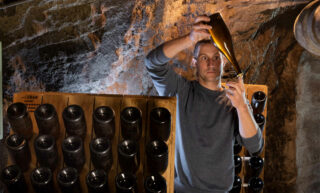
Coincidentally, when I visited Weingut Hansruedi Adank this spring, a bottling line operator was busy labeling a batch of 2019 Sauvignon Blanc that Friedrich had selected several years earlier: an Alter Torkel label on the front and an Adank label on the back. “We don’t influence the winemakers’ styles in any way,” Friedrich continues. However, one of his latest collaborations is with Luzi Jenny, who produced, exclusively for Alter Torkel, a just off-dry Riesling Kabinett that can stand its ground against its German brethren.
The vinous diversity of Graubünden explains why David Esser, head chef, always manages to create dishes befitting the wines. It also helps, as Esser and Friedrich explain, that, although the approach to wine is proudly local, the food philosophy is eclectically global. “It would be harder for me to serve exclusively French dishes, for instance, than to cook with only Bündner wine in mind,” Esser says.
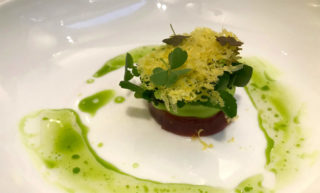
Thus, we drank a barrel-aged Completer that beautifully cut the crispy fried frog’s legs with a green herb vinaigrette, a well-balanced Malanser village Pinot Noir alongside ravioli stuffed with braised beef and drizzled with unctuous sage butter, and a voluptuous Sauvignon Blanc that could stand up to an Asian-leaning lion’s mane mushroom with spicy peanut sauce and sushi rice. On another visit, a lively, leesy sparkling Pinot Blanc (traditional method) provided a subtle counterpoint to a starter of lightly pickled spring vegetables with hummus, miso mayonnaise, and a labneh-inspired dressing with lime oil. My Lebanese dining companion (and I) wholeheartedly approved.

Frog legs Alter Torkel style ©Bart de Vries
At Alter Torkel, the menu changes every three months. For each cycle, Friedrich and his sommeliers choose a by-the-glass wine from around eighteen producers, a quarter of the wineries the restaurant features. It is then up to the head chef and his team of seven cooks to pair the wines with new dishes. The menu reflects the approach: The wines, clustered in five groups (“full-bodied and smooth,” “light, fresh and buoyant,” etc.) are mentioned first, with the matching dishes below.
The groupings help diners with their wine choice and thus facilitate the sommeliers’ work as well, although it must be said that the staff was ready to give advice. The suggested dishes, or at least the ones we tried, all perfectly paired with the chosen wines. “Initially,” Esser admits, “Oliver had to help us, but meanwhile our understanding of Bündner wines is up to par.” It shows. The dishes are accomplished, comforting, and inventive.
Aside from the by-the-glass choice, the main wine list, clustered by village, provides a 360-degree window on what Graubünden has to offer, including an impressive choice of large-format bottles. (Alter Torkel’s annual large bottle party is becoming a fixture on the Swiss wine trail.) Only some of the tiny hobby vintners are missing, as is, sadly, Gantenbein. These wineries aren’t members of Graubünden WEIN.
But it hardly matters. Alter Torkel effectively serves as a one-stop total Bündner wine immersion, that not only caters to wine lovers, but also to those who only want a glass and a Plättle, a plate with small snacks (first-come, first-served only). Moreover, Alter Torkel’s panoramic terrace and cozy dining room, dominated by a gigantic old wooden wine press, an alter Torkel in German, provide local vintners with a perfect location to demonstrate to their (inter)national relations what Bündner wine is all about.
Meanwhile, the restaurant’s reputation has spread. The clientele has now shifted from local villagers to urban dwellers, Friedrich says. With the launch of a new wine fair that explicitly targets foreign markets, and Swiss Wine stepping up its promotions abroad, I wouldn’t be surprised if the number of international guests increases as well.
Alter Torkel has thus evolved into the go-to place for Bündner wine and the kind of ambassador every appellation dreams of. Pinot Noir obviously forms the core of the wines on offer, but it is the diversity in styles and varieties that give the region and the restaurant depth. Finding the shiniest gems is Friedrich and his team’s ongoing achievement. Although Alter Torkel stands out through a combination of friendly service, great food, and a fantastic setting, it is this completeness and the focus of the wine list that makes it an indispensable stop on any Swiss wine tour.
This article was published in TRINK magazine volume 22, September 2025. TRINK is an American online magazine dedicated to the wines from the German speaking world.
Comments